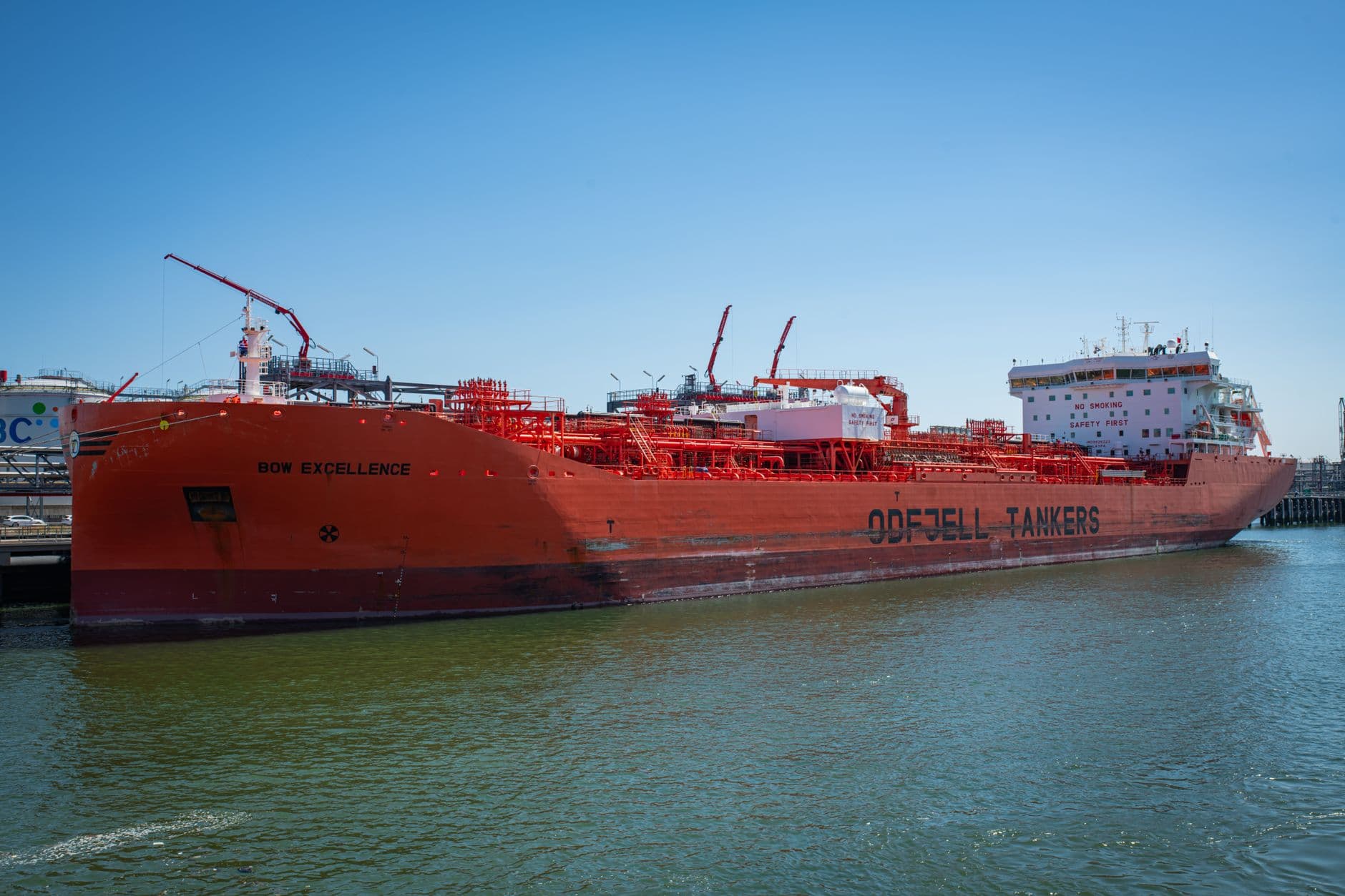
Forty-five tankers now sail the Strait of Hormuz with targets on their hulls. Iran published the list late Sunday, naming vessels tied to Saudi Arabia's Bahri and the UAE's ADNOC Logistics that it says violated its transit rules, and warning that any ship caught trading cargo with them could be added too. It is, depending on who's talking, either routine harassment or the opening shot in a new phase of a war that has already run six months.
Either way, the timing was not an accident. Treasury Secretary Scott Bessent is set to unveil what he has called the "single greatest financial offensive ever" against Tehran, a package President Trump has branded an "economic D-Day." Iran's response arrived before Bessent even reached the podium. Tehran's Supreme National Security Council chief, Mohsen Rezaei, warned that if neighboring states join the American pressure campaign, Iran would retaliate by choking off the one Hormuz route still functioning normally, vowing that "not even a single drop of oil will leave the region."
What makes this dangerous isn't the threat itself — Iran has threatened Hormuz before. It's that the oil market has stopped believing the crude side of the story while starting to believe the fuel side. That split, more than any single sanctions announcement, is what actually matters to anyone paying for gasoline or heat this winter.
A market split down the middle
TotalEnergies chief executive Patrick Pouyanne put it plainly at a conference in Stavanger: crude oil and refined products are now moving in opposite directions, calling it "a bearish crude oil market and a very bullish product markets, which is very strange." Crude tankers, he said, still transit Hormuz without much trouble; product carriers effectively don't, because higher shipping costs have stopped all refined product flows through the waterway even as crude keeps moving. The math explains why: shipping a very large crude carrier with capacity for 2 million barrels through Hormuz now costs about $20 million, a toll smaller product tankers simply can't absorb.
Layer onto that a separate supply hit — Ukrainian drone strikes have cut fuel supplies out of Russia by roughly 3 to 3.5 million barrels a day — and you get a distillate market starved even while crude storage tanks look fine. Pouyanne's verdict was blunt: European drivers "will suffer on this one," and in the U.S. "gasoline prices would not go lower than $4 as President Trump would like." September WTI futures settled at $88.15/bbl on Thursday, up +2.50%, while October Brent closed at $93.87/bbl, up +0.77% — both still well below the triple-digit spikes of earlier this year, which is exactly why the products story matters more than the headline crude number.
Washington insists the plumbing is holding regardless. Energy Secretary Chris Wright posted Friday that the seven-day average of oil leaving the Strait is over 8 million barrels a day, and that thanks to the U.S. Navy, oil is flowing through the Strait of Hormuz. That's the crude side of Pouyanne's split — moving, if bruised. The product side is the one quietly rationing itself out of European and American fuel tanks.
The chokepoint's other coastline
The same dynamic is reshaping Asia, just with gas instead of gasoline. Japan's day-ahead power price jumped 20% in a single week to hit its highest level since January 2023, according to OilPrice.com, as a summer heatwave collided with Middle East gas supply disruptions. Former IEA Executive Director Nobuo Tanaka has been telling anyone who'll listen that this is no ordinary squeeze. Reflecting on the string of Gulf disruptions, he told Semafor bluntly, "This is the third oil shock," adding that "just as the first and second oil shocks made a huge impact on the global economy, the third shock is a transformational moment." Natural Gas Intel reports he now sees the same forces pushing the world toward a "golden age" for LNG — a bet that Asian buyers, burned once, will pay up permanently for diversified supply rather than risk another Gulf-dependent squeeze.
Europe is discovering it may have to outbid Asia for that same LNG to survive winter. Goldman Sachs analysts Samantha Dart and Laura Cyr wrote that European gas prices will likely need to rise above €100 a megawatt-hour in December for the continent to rebuild enough inventory to last the winter, warning that even a recent rally in Dutch benchmark futures won't be enough to divert sufficient LNG from Asia if Middle East supply disruptions extend into next year. Henry Hub spot gas, per the latest EIA data, sat at $2.82 per MMBtu, up +1.81% — a domestic number that looks calm next to the transatlantic bidding war Goldman is describing.
The demand crack nobody priced in
Here's the twist that complicates the golden-age thesis: the world's largest crude importer may already be losing its appetite. Sinopec, China's biggest refiner, reported that road fuel demand plummeted in the first half as consumers shied away from higher prices and shifted to electric vehicles, with gasoline consumption falling 7.9% and diesel down 12%. That's not a forecast — it's a first-half earnings result, delivered while crude sat near wartime highs. If China's demand is cracking now, a "golden age" built on scarcity has a shorter shelf life than sellers might hope.
Energy stocks haven't caught up to that nuance yet. The Energy Select Sector SPDR closed at $63.64, down -0.17% on the session, but its 14-day RSI of 70.6 sits deep in overbought territory — a sector priced for a chokepoint crisis that the products data says is already here, and the demand data says may not last.
Bessent takes the podium Monday afternoon. Forty-five tankers are already watching the water behind them. Whatever he announces, the market has already told him which story it believes: not that Hormuz is closed, but that everything downstream of it — the diesel, the gasoline, the LNG cargo bound for Yokohama instead of Rotterdam — is quietly being rationed anyway.